LIFEHACKS
Vol.28

Designer
Y.T.
Wake Up Refreshed with Better Sleep!


Introduction
While we usually are not conscious of time while sleeping, the amount of time we spend asleep is actually the second longest portion of our lives after work.
When we go through life as usual, we rarely stop to think about it.
However, when you begin reflecting on how time exists within your own life, you may discover many interesting insights.
Let’s take a moment together to think about “time.”


We Spend One-Third of Our Lives Sleeping
Vol.15 “Does a Day Have Only 24 Hours?” introduced a pie chart showing how we spend our day, and sleep accounted for nearly one-third of the 24 hours.
If we assume a lifespan of 80 years, that means we spend nearly 27 years asleep.
Twenty-seven years! And most of it happens unconsciously!
There is a Japanese expression, “damin wo musaboru” (to indulge in idle sleep).
According to the Sanseido Daijirin dictionary, it means:
- To lazily spend time sleeping all the time
- To spend one’s days idly doing nothing
Doesn’t that make sleep sound somewhat negative?
However, sleep is never a waste of time—it is an essential part of human life.

Why do we sleep?
Sleep is important not only for resting the body, but also for allowing the brain to recover.
Physical fatigue can be relieved to some extent simply by lying down, but the cerebrum—which controls consciousness, intelligence, and memory—cannot truly rest while we are awake.
Sleep allows the brain to enter a deep resting state and recover from mental fatigue.
There is also an old saying, “Children grow while they sleep.” During deep sleep, growth hormones are released.
These hormones boost metabolism, support the growth of skin, muscles, and bones, and efficiently repair muscles and internal organs damaged through daytime activities.
In this way, sleep is absolutely necessary for maintaining both mental and physical health. It is not laziness or wasted time, but an essential source of energy for the next day.
12 Tips for Better Sleep
So, how can we help our internal body clock maintain a healthy rhythm and achieve better sleep?
Dr. Naohisa Uchimura of the Kurume University School of Medicine has proposed 12 tips for regulating the body clock.
12 Rules for Regulating Your Body Clock
-

Rule 1
When you wake up in the morning, open the curtains and let sunlight into the room. -
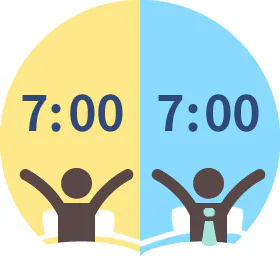
Rule 2
On weekends, try not to shift your wake-up time by more than two hours from weekdays. -

Rule 3
Start your day’s activities with breakfast. -
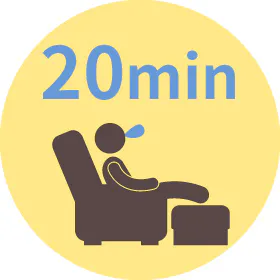
Rule 4
If you take a nap, keep it within 20–30 minutes and before 3 PM. -

Rule 5
Develop a habit of light exercise. -

Rule 6
Avoid tea and coffee within four hours before bedtime. -

Rule 7
Finish eating at least two hours before going to bed. -

Rule 8
Stop smoking at least one hour before bedtime. -

Rule 9
Take a lukewarm bath one to two hours before bedtime. -

Rule 10
Keep the room lighting from being too bright. -
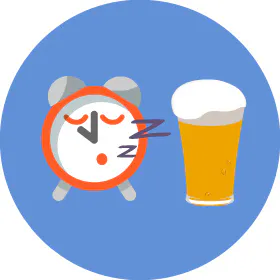
Rule 11
Avoid drinking alcohol as a sleep aid. -
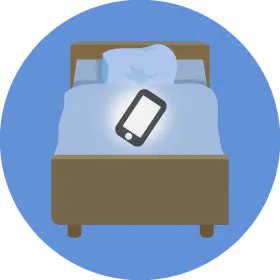
Rule 12
Avoid using computers, watching TV, using mobile phones, or playing video games before bedtime.
Conclusion
Our internal body clocks can easily become disrupted due to irregular lifestyles such as varying work schedules, overtime, lack of exercise, and staying up late.
When this disruption continues, it can throw off our natural rhythms and eventually lead to insomnia.
By keeping these “12 Rules for Regulating Your Body Clock” in mind, let’s aim for better sleep and wake up to more refreshing mornings!



RECENT POSTS

Vol.203
What Is Design Management

Vol.202
Why Hiring No Longer Works— Redesigning Organizations and Decisions for an Uncertain Age

Vol.201
How to Choose a Branding Agency: 5 Criteria to Avoid Failure

Vol.200
Design Management: A Practical Guide for SMEs and Startups to Drive Real Results

Vol.199
How to Rebuild Brand Competitiveness: A Practical Guide to Brand Management for SMEs

Vol.198
From parent–child bonds to community: The future of education that nurtures diversity and designs relationships


