DESIGN
Vol.84

Designer
N.S.
Etiquette and Design Tips for Creating New Year's Cards


The Basics of New Year's Cards
What is "Shōgatsu" (New Year)?
First, Shōgatsu (the Japanese New Year) is the custom of welcoming "Toshigami-sama" (the god of the year). The 1st is called Ganjitsu (New Year's Day), the days through the 3rd are called "San-ga-nichi" (the first three days), and the days through the 7th are called "Matsu-no-uchi."
Who to Send New Year's Cards To
Send them to people who sent you a New Year's card the previous year, as well as those who have helped you during the current year.
When to Send Them
Aim for the card to arrive by January 3rd. Replies to New Year's cards you receive should arrive within Matsu-no-uchi. Missing the appropriate timing is considered impolite.
If your reply will arrive after Matsu-no-uchi, send a "Kanchū-mimai" (winter greeting card) instead of a New Year's card.
Also, when using regular postcards or privately made postcards, be sure to write "年賀" (Nenga) in red ink. Without this, the card will be delivered as regular mail before the year ends.
Send a Mourning Notice When in Mourning
If you are in mourning and wish to decline sending New Year's cards, send a "Ketsurei-jō" (mourning notice). Make sure to send it before the recipient starts preparing their New Year's cards.
Watch Out for Typos
Once you've finished writing everything, carefully check for any typos or omissions.
What to Write on a New Year's Card
The Greeting (Gashi)
Always include a New Year's greeting such as "Kinga Shinnen" (Happy New Year).
When sending to someone of higher status, avoid two-character greetings. Two-character greetings like "Gashō" or "Geishun" lack the respectful nuance of words like "humbly" or "reverently," and may seem less polite.
Also, be careful not to overlap meanings in the greeting.
If you've already written a greeting like "Gashō" or "Happy New Year," writing "Akemashite Omedetō Gozaimasu" in the main text creates redundancy.
"Shinnen Akemashite Omedetō Gozaimasu" is a commonly seen phrase, but the meanings of "Shinnen" (New Year) and "Akemashite" overlap. Write either "Shinnen Omedetō Gozaimasu" or "Akemashite Omedetō Gozaimasu."
Also, the often-seen phrase "A Happy New Year" doesn't need the "A" at the beginning. In standard expressions found on Christmas cards like "Merry Christmas and a happy new year," the "a" is appropriate.
Thanks for the Past Year and Recent Updates
Write expressions of gratitude for the support you received and share recent updates. Keep the text concise and avoid gloomy topics. Also, add words wishing the recipient health and happiness to show that you care. Even if you don't write the entire card by hand, adding a handwritten note makes a better impression.
Writing Etiquette
Avoid Inauspicious Words
Imi-kotoba are words that should not be used because they are considered inauspicious. Avoid expressions that might suggest misfortune to the recipient.
The "去" in "去年" (last year) carries the meaning of "leaving" or "departing," which is not appropriate for the New Year. Use "昨年" or "旧年" instead. Other words to avoid include "切れる" (to cut/break), "落ちる" (to fall), "終わる" (to end), and "離れる" (to separate).
The Difference Between "Yorokobi" (喜) and "Yorokobi" (慶)
"喜" is used when you feel emotionally joyful. It can also be used when speaking about yourself.
"慶" is used when celebrating something auspicious—such as congratulating others on happy occasions like the New Year or a wedding. It cannot be used when referring to yourself.
Therefore, for New Year's greetings, either character is acceptable.
How to Write "Gantan" (New Year's Day)
"Gantan" means "the morning of January 1st," so writing "1月元旦" (January Gantan) is incorrect. Write "2018年元旦" (Gantan 2018) or "平成30年元旦" (Heisei 30 Gantan).
Don't Use Punctuation Marks
It is traditionally proper not to use punctuation marks such as "、" (comma) or "。" (period) in New Year's cards. Make your text easy to read by using line breaks or spaces instead.
How to Address Cards Without Being Rude
When Sending to an Individual
It is common to use "Sama" (様). It can be used with anyone.
Example) Suzuki Ichiro-sama
For couples or family members listed together, attach "Sama" to each name.
Example) Suzuki Ichiro-sama
Hanako-sama
When Sending to Business Partners or Companies
When sending to a company, use "Onchū" (御中). Be sure to spell out "Kabushiki-gaisha" (Co., Ltd.) or "Yūgen-gaisha" (Limited Co.) without abbreviation.
Example) ○○○○ Co., Ltd. Onchū
If including a department, attach "Onchū" to the department name.
Example) ○○○○ Co., Ltd. Sales Department Onchū
When sending to a specific person, do not attach "Onchū" to the company name; instead, attach "Sama" to the person's name.
Example) ○○○○ Co., Ltd. Suzuki Ichiro-sama
When including a job title, write it above the name in a smaller font. Since the job title itself is honorific, adding "Sama" to it (e.g., "Kachō-sama") is incorrect.
Example) President Suzuki Ichiro-sama
Design Examples for New Year's Cards
Use Auspicious Motifs
・Shō-chiku-bai (Pine, Bamboo, and Plum)
Pine stays evergreen throughout the year, bamboo grows straight upward, and plum blossoms bloom in the harsh cold—qualities that have made them long-standing symbols of good fortune.
・Folding Fan (Ōgi)
With its expanding shape, the folding fan is an auspicious motif symbolizing growth and prosperity, representing a future that opens up ever wider.
Feature the Zodiac Character as the Main Element
You can use the character itself as a motif, or combine it with illustrations to express the zodiac animal of the year.
Example)
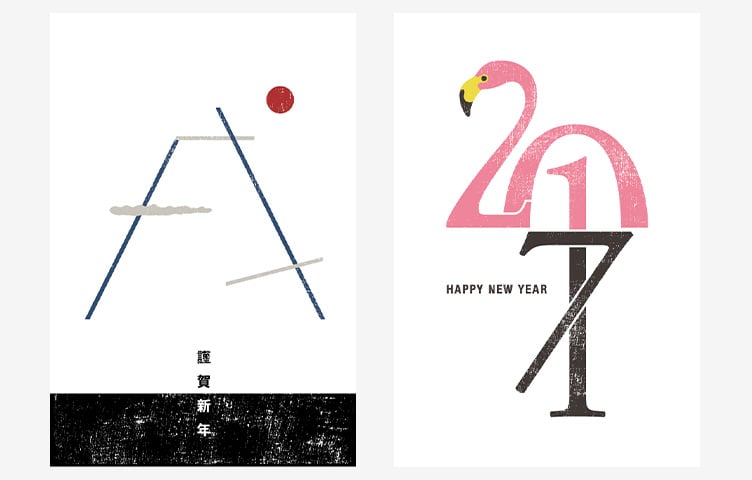
Reference site (right): New Year's Card 2018 No.15
Reference site (left): New Year's Card 2018 No.17
Limit the Number of Colors and Unify Tones
Using around three colors gives a clean, well-organized look. If you want to use many colors, unify the tones.
When going for a Japanese-style design, traditional Japanese colors blend beautifully.
The following site lets you view traditional Japanese colors along with their color codes and palette combinations.
"Wairo Daijiten" (Traditional Japanese Color Dictionary)
We also introduce traditional Japanese colors here:
"TIPS vol.21 DESIGN: Colors Passed Down from Ancient Japan—The Charm of Beautiful Traditional Colors"
Choose a Different Paper
Changing the paper can make an impact through both its appearance and texture. We introduce some recommended papers here.
"TIPS vol.35 DESIGN: 10 Papers Recommended for 2016 New Year's Cards"
Conclusion
I've gone into a lot of detail, but don't be too strict with yourself—try to create New Year's cards that reflect your own style.
Be sure to mail them by December 25.
※In June, the cost of postcards was raised from 52 yen to 62 yen, but New Year's postcards mailed between December 15 and January 7 of the following year can still be sent at the rate of 52 yen (during this period, privately made postcards can also be sent at 52 yen as long as "年賀" (Nenga) is clearly written in red on the front).
Outside of this period—either earlier or later—they will be treated as regular mail (62 yen), so please be careful.
Reference: "Manners You Can Master, Customs You Can Understand: A Handy Guide to Ceremonial Etiquette," 2014, Takahashi Shoten "Design Note 2016 No.67"
Reference: "When Should You Send 2020 New Year's Cards? A 3-Minute Guide to Proper Writing and Etiquette"
Reference: "What Words Should You Avoid? New Year's Card Greetings (Set Phrases) and How to Write the Date"
Reference: "Is Horizontal Writing a No-Go? Rules and Etiquette for Addressing Cards"
Reference: "From When Are New Year's Cards Accepted?"
Reference: "Tokyo National Museum"
Reference: "Cardbox Staff Blog for New Year's, Mourning, and Greeting Cards"
RECENT POSTS

Vol.203
What Is Design Management

Vol.202
Why Hiring No Longer Works— Redesigning Organizations and Decisions for an Uncertain Age

Vol.201
How to Choose a Branding Agency: 5 Criteria to Avoid Failure

Vol.200
Design Management: A Practical Guide for SMEs and Startups to Drive Real Results

Vol.199
How to Rebuild Brand Competitiveness: A Practical Guide to Brand Management for SMEs

Vol.198
From parent–child bonds to community: The future of education that nurtures diversity and designs relationships