DESIGN
Vol.181

Strategic Designer
T.M.
What is Design Thinking? A Thorough Explanation from the Basics to Its Evolved Forms
You may have heard comments such as “Design thinking is already outdated.” Behind these words lies the fact that design thinking has sometimes been treated as a fleeting trend; superficial techniques were copied without true substance, and with rapid changes in people’s behaviour and technologies like AI, many claim it has lost relevance. However, the idea that design thinking is no longer useful is a major misunderstanding. Design thinking is not declining—it is rather transforming, being applied to wider domains, and evolving.
In this article, we explain design thinking from the ground up, with clarity even for beginners: its foundations, current trends, and how to actually put it into practice. Furthermore, we clarify why a “human-centred” mindset remains indispensable as a bridge to next-generation approaches such as speculative design.
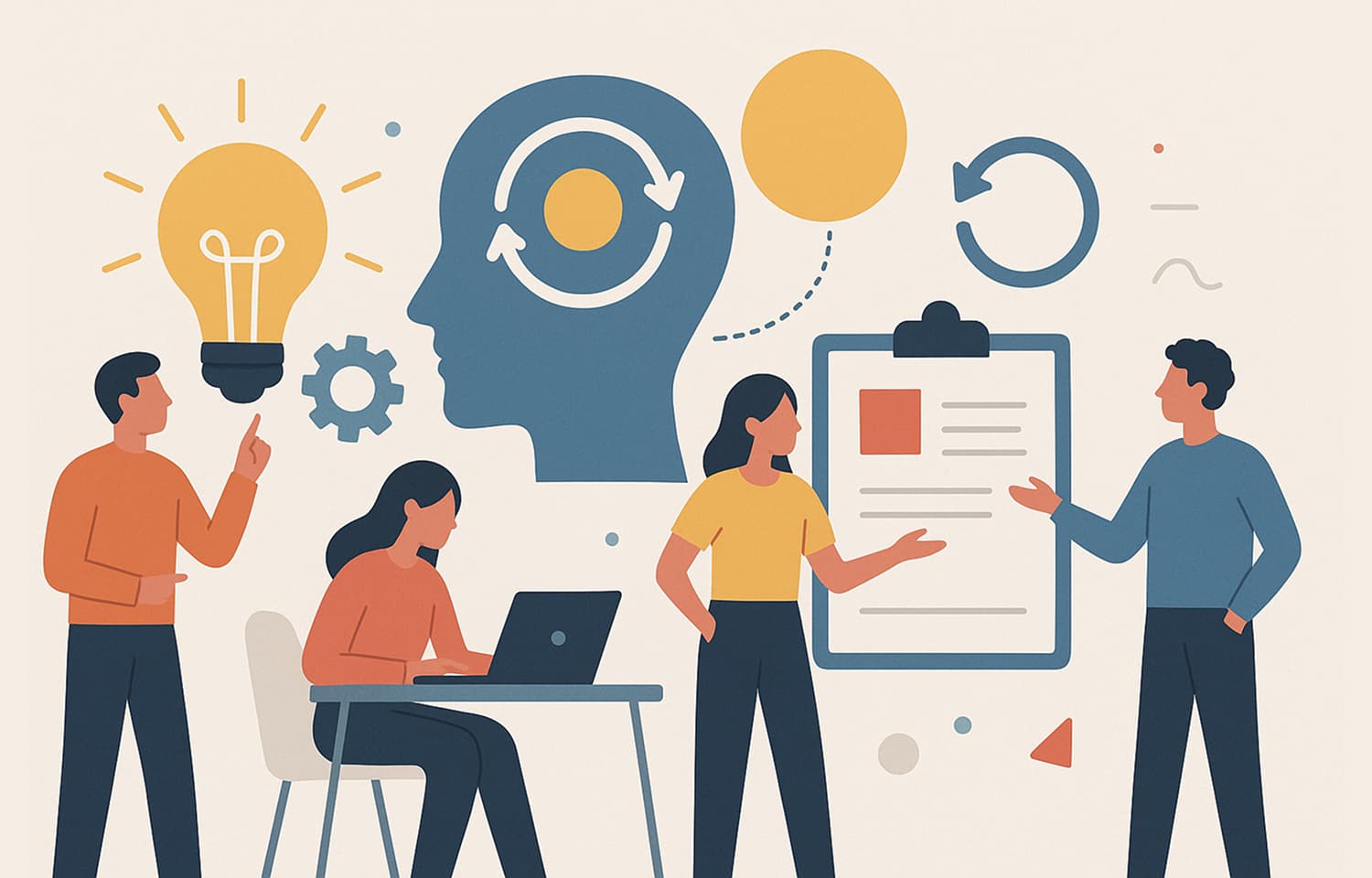
1. Fundamental Knowledge of Design Thinking
First, we will introduce what design thinking actually is, along with its core concepts, origins, and historical background.
Definition and Basic Concept of Design Thinking
“Design thinking” is a methodology that places the user’s viewpoint at the centre, aiming to derive creative and feasible solutions. The key word here is “human-centred”. Rather than simply improving appearance, this method is about deeply understanding humans’ needs and behavioural patterns, and then creating solutions based on that understanding. Originally, it was the informal process that designers naturally undertook when developing products; nowadays it is widely used in business, education, and government.
Historical lineage and evolution of design thinking
In the 1980s–90s, competition centred on product functions and price. However, in the 2000s user experience (UX) began to be emphasised, and ideas needed to align with customer emotions and lifestyles. At that time, the human-centred design concept proposed by IDEO (led by Tim Brown) gained attention.
IDEO, a U.S. design firm based in Palo Alto, has been active since 1991, and in the early 2000s, during the growth of the internet and information society, design thinking emerged. CEO Tim Brown redefined design as a “methodology for problem-solving” and spread this into the business world. Subsequently, design thinking extended beyond business into education. In 2003, the d.school (Stanford University) was established at Stanford University to offer systematic learning of design thinking, producing many innovators. In Japan, the i.school, University of Tokyo was established in 2009. Non-design students and business people began to learn design as an approach to problem discovery and solving.
2. Tim Brown’s Three-Element Model and the Double Diamond
Tim Brown defines design thinking as a human-centred approach to innovation, one that integrates people’s needs, technological possibilities, and business success conditions.
Three-element model
Brown’s model involves three key indicators, and he states that the overlapping area of these three is essential for successful innovation:
Desirability (people’s desires/needs)
What users or customers really want; improving emotional experience or quality of life – a human-centred view.
Feasibility (technical standpoint)
Whether it is technically possible; development resources, infrastructure, cost viewpoint.
Viability (business sustainability/profitability)
Whether the business will stand and be sustainable; from a revenue and management sustainability view.
The area where all three overlap is where sustainable, valuable solutions (i.e., successful solutions) exist.
Three-element model
Double Diamond Model
Proposed by the Design Council (UK), the “Double Diamond” model explains the process of problem-solving through repeating “divergence” and “convergence” between Discover → Develop phases. This flow closely corresponds to the six-step design thinking process (Empathise → Define → Ideate → Prototype → Test → Implement).
◇The First Diamond◇
The first diamond focuses on the process of understanding and defining the problem.
It moves from divergence (Discover) to convergence (Define), forming a structure of exploration → definition.
The goal of this phase is to define the right problem to solve.
Discover:
In this process, designers explore users’ situations and challenges broadly. Methods such as user interviews, observational research, and data analysis are used to uncover hidden needs and insights that users actually face—rather than assumptions made by the team. The key here is to identify what the real problems are from the user’s perspective.
Define:
In this phase, the insights collected during the Discover stage are organised to clarify the essence and core of the problem. Common methods include persona development and customer journey mapping. The focus is on selecting and prioritising diverse information to ensure that the team reaches a shared understanding and agreement on the right problem definition.
◆The Second Diamond◆
The second diamond deals with the process of creating and implementing solutions. It progresses from a divergent phase, where a wide range of ideas are generated, to a convergent phase, where the most promising ideas are refined and implemented. This is represented as Develop → Deliver.
Develop:
In this phase, teams generate diverse ideas and potential solutions to the problems defined in the first diamond. Methods such as brainstorming, prototyping, idea sketching, and workshops are used to freely express ideas. The emphasis here is on quantity and diversity, rather than immediate feasibility.
Deliver:
At this stage, the ideas have taken tangible form, and the process moves toward implementing the optimal solution through repeated prototyping and testing. User testing is typically conducted to review user reactions and incorporate feedback, refining the solution to deliver genuine value. It is essential to ensure that the final output becomes a truly valuable and effective solution for the user.
Figure 2: The Double Diamond Problem-Solving Process
Figure 3: The Relationship Between the Double Diamond Model and the Six Steps of Design Thinking
3. The Six Steps of Design Thinking
The framework developed by Stanford’s d.school originally listed five steps (Empathise → Define → Ideate → Prototype → Test). Here we present a six-step version including Implementation/Launch.
1. Empathise
Conduct user interviews or observation to discover needs. Methods include Contextual Inquiry (visiting the user’s environment), Shadowing (observing users in their daily life), Ethnography (embedding in users’ environment), and creating a Customer Journey Map to design user behaviours, thoughts, emotions, and touchpoints. It is key to include extreme users and non-users to eliminate assumptions.
2. Define
ユーザーのインサイトやニーズに関する情報データが得られたところで、課題を明確化し、解決の方向性を設定するフェーズに入ります。この段階での目的は、問題を”解ける”形に細分化して、チームで合意した焦点を定めることにあります。このフェーズでは、まず親和図法とも呼ばれるAffinity図法やKJ法を用いたインサイトの収束から始めます。
Affiniy図法とは、大量のデータ(例:インタビュー結果、観察メモやアイディアなど)を意味の近さや類似性(親和性)でグルーピングする手法で、ビジネス現場で「付箋をまとめる」方法として広く用いられています。スピード感があり、実務に馴染みやすく、チームで共通認識を作る場に有効です。しかし、KJ法に比べて「深い構造化」や「文章化による洞察」は弱めです。
KJ法とは、文化人類学者である川喜田二郎氏が開発した「質的データの整理・分析法でAffinity図法ももともとはKJ法をルーツとしています。本来はフィールドワークなど膨大な記述を創造的に構造化するための学術的手法として用いられてきました。Affinity図法よりも手順が厳格で、グルーピング→関係付け→図解→文章化まで行い、より分析・研究よりで深い洞察や仮説の構築を強みとしている点が特徴です。
インサイトを収束する意義は、種々雑多な発見に基づく観察、引用や数値を”意味のかたまり”として凝縮して、問題の本質を炙り出すことにあります。インサイトの収束を経て、問題文の再定義を行います。ここでは以下の流れに沿って、文章にして考えることを重要視しています。
問題文作成の流れ:事実→インサイト→ニーズ→POV→HMW
ここでは、POVとHMWについて例とともに簡単に触れておきます。
POV(Point of view)
まずは、ユーザー視点での”問題・課題の芯”を一文で言い切ることが重要です。書式は、【誰が】、どういった【状況】において、【何に困っている/何ができずに困っている】があります。
(例)図書館の利用体験の改善をテーマとするならば、「小さな子どもを持つ保護者は、子どもが飽きずに過ごす工夫を求めている。なぜなら、図書館を利用したいが、子どもが退屈すると滞在を続けられないことに困っているから」
HMW(How might we…?)
POVをもとに「どうすれば〜できるだろうか?」と解決の探求質問に変換します。「では、どうしていこうか?」といった自問の形式でOKです。
(例)・「どうすれば子どもが飽きずに楽しみながら過ごせる図書館体験をつくれるだろうか?」 ・「どうすれば親が安心して利用できる、子ども向けの学び空間を設計できるだろうか?」
問題文の再定義を経て、効果指標であるとか、制約や前提といった成功基準の明文化をしていきます。注意点は、絞ったつもりの課題をかえって拡げ過ぎてしまったり、問題や課題を抽出するべき段階であるのに、仮説に基づく解決案を混ぜてしまうといったことがあります。このフェーズではあくまでも”問題文”に止めることが重要です。
③創造する(Ideate)
問題や課題がどこにあるのか?を明文化した時点で、ブレインストーミングなどで幅広くアイデアを出す発想のフェーズに入ります。ここでは、多様で大胆な解決案を量と質の両側面から生み出すことを目的としていますので、まずは時間を区切ってたくさん出すことを意識してアイディアを出し、量を担保しましょう。後の工程である発想〜テストで、「何をもって良しとするのか?」といった判断基準で迷わないためにも、合意済みの物差しや基準がアイディア選定やピボット判断の際の衝突を防ぎます。
具体的な方法としては、チームでアイディアを幅広く出す際には、ブレインライティングの手法を用いて大量のアイディアを収集したりしますが、なかなかアイディアが出ずに行き詰まった場合には、クレイジー8Sという、Google Venturesが提唱するアイディア出しの方法も有効かもしれません。A4用紙を8分割にし、各スペースに1アイディアとして8分で8アイディアを出していきます。限られた制限時間内に思考をロックすることで、直感的で奇抜なアイディアに出会えることが強みです。他にもアイディア出しの方法としては、既存の製品やサービスを異なる視線で改良できないか考えるSCAMPERという方法や、イノベーションや新規事業探索の際に向いているとされ、他分野や他業界、他文化をヒントにして新しい発想に変えるアナロジー発想を加えた4つの手法が代表的です。
④プロトタイプを作る(Prototype)
”考えるために”を目的とした試作品を迅速に作り、早期に形にするフェーズです。とにかく最低限でいいので、仮説を可視化して検証可能な状態にすることが目標ですので、まずは低忠実度のものからスタートします。そこから、体験ストーリーボードやサービスブループリントを作成して、リスクの高い仮説から順に”学習のための実験”を設計していきます。サービスブループリントに関して詳しく知りたい方は顧客や従業員の体験を可視化するサービスブループリントをご覧ください。
ここで注意しなければならないのは、作り込み過ぎることです。目的はあくまで”考え学ぶこと”にあります。惜しまず捨てられる粗さで構わないので、まずは仮説を可視化することに集中しましょう。また、価値提案、料金感や導入フローを可視化することも重要です。
⑤テストする(Test)
仮説を可視化するプロトタイプの段階を経て、テスト段階に入ります。このフェーズでは、ユーザーの行動や発言、反応などを通じて仮説の検証をします。ユーザーや関係者からのフィードバックを得て、それを活かすことで、試作段階の商品やサービスにより磨きをかけていきます。手法としては一連のユーザビリティテストやユーザーの理解度や魅力度、価値受容度を測るコンセプトテスト、またLPや広告で受容シグナルを計測するスモークテストと呼ばれる方法も用いられます。注意点は、どのユーザー集団からサンプルを抽出するのかといった点で、身内のターゲット母集団にしたことで偏重したデータになってしまうことや、ユーザーの主観的な自己申告に頼ってしまうことです。ここでは客観的に測れる行動データ(クリック/離脱)を重視するようにしましょう。
⑥実装/展開する(Implement/Launch)
ユーザーテストを繰り返して検証・改善を加えて、いよいよ最終的に市場や現場に導入する実装/展開を迎えます。この最終フェーズでは、テストからの学びをプロダクトやサービスに反映し、現場運用に乗せて価値を継続的に提供していくことが目的となります。本番の運用を見据えた運用手順書の作成、機能フラグの活用はもちろん、組織へのオンボーディングや計測設計のための定義や基盤の作成をしていきます。
最も重要なことは、「作って終わり」にしないことです。せっかくこれまでユーザーの価値に則したプロダクトやサービスを作っても、計測×改善、PDCAのループを切ってしまっては、いつまでもユーザーに支持されることは難しいでしょう。また、製品やサービスを送り出す現場が未整備な状態では、運用段階でつまづくことにもなりかねません。トレーニングや顧客とのコミュニケーションの設計、計画も同時並行で整備していくことが求められます。
実装のその先にある意味と世界観
スタンフォード・デザインスクールが体系化したデザイン思考の6つのステップについて、明快で使いやすい反面、テンプレートとして段階的、また機械的に作業を進めていくと、デザインの本質と少しズレるような感じがするという意見を、アートセンターのアンディ・オグデンや他のファカルティが出しています。どうしても、この枠組みを実践で活用する場合には、各ステップを行ったり来たりすることがありますが、それを恐れないことが成功への鍵です。
デザイン思考の実践を通して得られた洞察・統合作業をもとに創造される「世界観」、製品やサービスに対するユーザーにとっての「意味」、そして「ビジョン」が密接につながっているように考えられます。デザイン思考によって新たに提案された世界観や、その中で創造された製品やサービス、ビジネスモデルが新しい意味をユーザーに与え、それがユーザーシナリオとなっていくのです。
世界観を把握する上で、わかりやすい例を挙げるならば、スタジオジブリとディズニーです。スタジオジブリが描く世界観はディズニーの描く世界観とは異なり、独自性があり想像力豊かなものです。また、ディズニーも独自の世界観や空間の創出に成功していますし、どちらもユーザーにとっては一目でその世界観を捉え、提供される意味を感じることのできる体系となっています。
世界のユーザーの共感を呼ぶ世界観を創出し、その世界に到達するように新しいアイディアを出し、それがブランドにつながっていく。成功しているブランドは、こうしたステップや流れを踏襲しているのです。やはり、そこで鍵となるのは、「共感を生む世界観と意味」でしょう。
4. The evolution and future of Design thinking
Up to this point, we have introduced the concepts and methods of design thinking. However, design thinking is no longer limited to product development alone; it continues to evolve as an approach to tackling increasingly complex and multilayered challenges, with applications expanding into areas such as organizational transformation, public policy, and education. This evolution is closely tied to the growing complexity of the problems facing society today—issues that can no longer be addressed through single, straightforward solutions.
Challenges such as climate change, demographic shifts, and digitalization cannot be adequately handled through conventional problem-solving processes alone. As a result, further evolution and expansion of design thinking are being called for. In response, growing attention is being paid to the integration of design thinking with thought processes from other disciplines.
Integration with Other Approaches such as Service Design and Systems Thinking
While design thinking excels at solving individual, clearly defined problems, many of today’s challenges require the design of entire service experiences and the optimization of interdependent systems as a whole. From this perspective, integration with service design and systems thinking is becoming increasingly important.
Service design is an approach that views the entire set of customer touchpoints as a “service journey” and designs a comprehensive user experience that includes not only the moment of service use but also the stages before and after. This makes it possible to translate user insights gained through design thinking into more practical, operationally grounded services.
Systems thinking, on the other hand, is a framework for understanding the overall structure in which multiple elements interact with one another and for designing optimal solutions at the level of the whole rather than in isolated parts. When addressing large-scale, complex social challenges—such as environmental issues or urban policy—it is essential to combine the human-centered approach of design thinking with the holistic, big-picture perspective of systems thinking. By doing so, efforts move beyond merely solving isolated problems and instead contribute to the design of more sustainable social systems.
Connection to speculative design
Although design thinking is strong for solving current problems, there is also a movement to link it with future-oriented approaches for addressing highly uncertain challenges. One example is speculative design.
Speculative design presents “what if” scenarios based on future changes in technology and society, and, by working backwards from desirable futures, seeks to discover problems and issues that do not yet exist. Its goal is not immediate product/service development but to question values and ethics in society.
By connecting design thinking with speculative design, a “two-layered design practice” becomes possible: one that addresses short-term problem solving and also considers long-term future scenarios. By exploring future possibilities while keeping current constraints in mind, we can generate more sustainable and ethical solutions.
What design thinking must look like moving forward
Design thinking is not a mere business buzzword—it is a methodology for human-centred problem solving, and its range of application is expanding.
Its importance continues to increase in areas such as AI, IoT, sustainability, and social inclusion. The point is not only the “method”, but how deeply the attitude of design thinking is embedded—i.e., the “ability to pose the right questions.”
Many conventional problem-solving approaches emphasise how efficiently to find answers to a given problem. But many of today’s societal challenges share features like: “The problem itself is unclear” or “It’s not decided which problem should be prioritised.” When you don’t clearly know what problem you’re facing, you cannot know what to tackle. Thus, the ability to accurately frame the problem will become ever more emphasised.
The next stage of design thinking will be based on “asking the question”, and by combining it with speculative design, future-insight, scenario planning, and other methods, it will become an orientation for creating sustainable and adaptable solutions in a highly uncertain society.
Summary
Design thinking is not a method that has “ended.” Rather, it continues to evolve in response to the demands of the times. It is expanding beyond conventional product development and service improvement to address societal challenges and future uncertainties. To understand design thinking, it’s key to first learn concepts such as the “Three-element model (Desirability, Feasibility, Viability)” and the “Double Diamond model.” These underscore that design thinking is not just an ideation method but a process of exploration and integration. By following the six steps—Empathise, Define, Ideate, Prototype, Test, Implement—you can design truly human-centred approaches. Furthermore, by combining design thinking with next-generation methods like speculative design you can move beyond solving today’s problems to discovering new issues and formulating new questions for the future. In short, the true nature of design thinking is a flexible mindset that adapts across domains—and at its core remains human experience and value. Therefore, design thinking will continue to be a vital approach for shaping the future.
Ref:
the Faculty of Design, Kyushu University.「Design Thinking」
・The history of design thinking
・British Design Council
・『"Strategic Creativity: Awareness through Drucker, Creation through Design Thinking, and Strategy Implementation through Porter" by Hideki Yamawaki
RECENT POSTS

Vol.198
From parent–child bonds to community: The future of education that nurtures diversity and designs relationships

Vol.197
Exploring the future of environmental design integrating vision, diversity, and a future-oriented perspective

Vol.196
Vision-making for diverse and future-oriented education: Interpreting the future of learning through environmental design

Vol.195
“One Health” and Japan — Toward an Era of Integrating Humans, Animals, and the Environment

Vol.194
The benefits and challenges of digital education in the AI era, and the future of learning

Vol.193
Vision-Making in the age of AI — How artificial intelligence is transforming the meaning of work and the nature of organizations