BRANDING
Vol.157

T.T
Service Blueprinting to Visualize Customer & Employee Experiences
What is a Service Blueprint?
A service blueprint is one of the core tools used in service design. It is a visual diagram that illustrates, in chronological order, the entire process through which a service is delivered to the user.
The concept was first introduced in 1984 by G. Lynn Shostack in her Harvard Business Review article, “Designing Services That Deliver.” This tool functions as a kind of architectural plan for service delivery, helping teams design, analyse, and improve both the structure and operation of a service.
The word “blueprint” originally referred to a photographic reproduction of technical drawings used for copying architectural plans. Over time, it came to mean “a master plan,” “a conceptual outline,” or “a vision for the future.”
In summary, a service blueprint can be described as:
- • A tool that visualises the user experience and the service delivery process.
- • A diagram that represents both the front stage (visible to users) and the backstage (internal operations).
- • A map that illustrates the service flow over time.
- • An analytical framework for identifying and improving areas within the service.
Expected Benefits of Using a Service Blueprint
Implementing a service blueprint can bring a wide range of benefits — from improving service quality and streamlining operations to delivering more creative and seamless customer experiences.
1. Improving the customer experience and refining processes at the same time
- ユーザーが抱える課題やサービスに対する期待を細かく洗い出し、ブランド(企業)側の必要な行動を可視化し明確化できる
- ユーザーに対して無駄のない動線やエラーを減らす設計が可能になる
2. Enhancing Team Communication and Streamlining Requirement Definition
- 誰がどのタイミングで何をするかが可視化され、認識のずれや連携のミスを減らすことができる
- フローを可視化することで部門横断的な役割や理解が促進され、協力してサービスの向上を目指すことができる
3. Optimising the service delivery process
- 問題点や改善の余地を明確にし、業務のボトルネックを特定できる
- リソースの配分や業務の再構築が容易になり、全体のパフォーマンスを向上することができる
4. Increasing Customer Satisfaction
- サービスの各ステップと関連するプロセスを詳細に一枚の絵に示すことで、顧客体験の全体像を把握し改善につなげられる
- 顧客が待つ時間やサービスに対する不満、悩みを特定することが可能となる
5. Designing New Services More Effectively
- 必要なリソースを把握したりサービスに潜む弱みや問題点を事前に把握することができる
- 一貫性のある顧客体験を提供することができる
6. Competitive Analysis and Differentiation
- 自社のサービスと競合サービスの比較が容易になり、強み、弱みなど差別化するポイントを特定することができる
7. More Efficient Internal Education and Training
- 従業員の役割と責任が明確になり、サービスの全体像の理解促進や参加意欲の向上につなげることができる
Advantages and Disadvantages of a Service Blueprint
Advantages
- サービス全体の流れを俯瞰することができる
- サービスがユーザーに提供されるまでの問題点や改善箇所を特定しやすい
- 関係者間のコミュニケーションツールとして有効に機能する
- ユーザー視点(受け手)と提供者視点(発信者)の両方を考慮できる
Disadvantages
- 作成するのに時間とリソースがかかる場合がある
- プロセスやフローを詳細に作りすぎるとサービスの全体像が見えにくくなる
- サービスブループリントを作成すること自体が目的化してしまう危険性がある
Concrete Steps for Creating a Service Blueprint
Here are the four basic steps for creating a service blueprint:
- 1. Map Customer Actions
Identify and visualise the actions taken by the customer or user throughout the service experience. - 2. Add Frontstage Actions
Include the actions that occur in front of the customer—those that are visible and directly affect the customer’s experience. - 3. Add Backstage Actions
Add the actions that happen behind the scenes, which the customer does not see—such as staff or partner activities that support the service. - 4. Add Support Processes
Incorporate the internal processes and systems that support employees and ensure smooth service delivery.
By organising these steps, you can visualise, in chronological order, how information and materials flow among all the people and systems involved—such as staff at various touchpoints, suppliers, partners, back-office teams, and digital systems—and how they connect to the customer experience.
Key Points to Keep in Mind When Creating a Service Blueprint
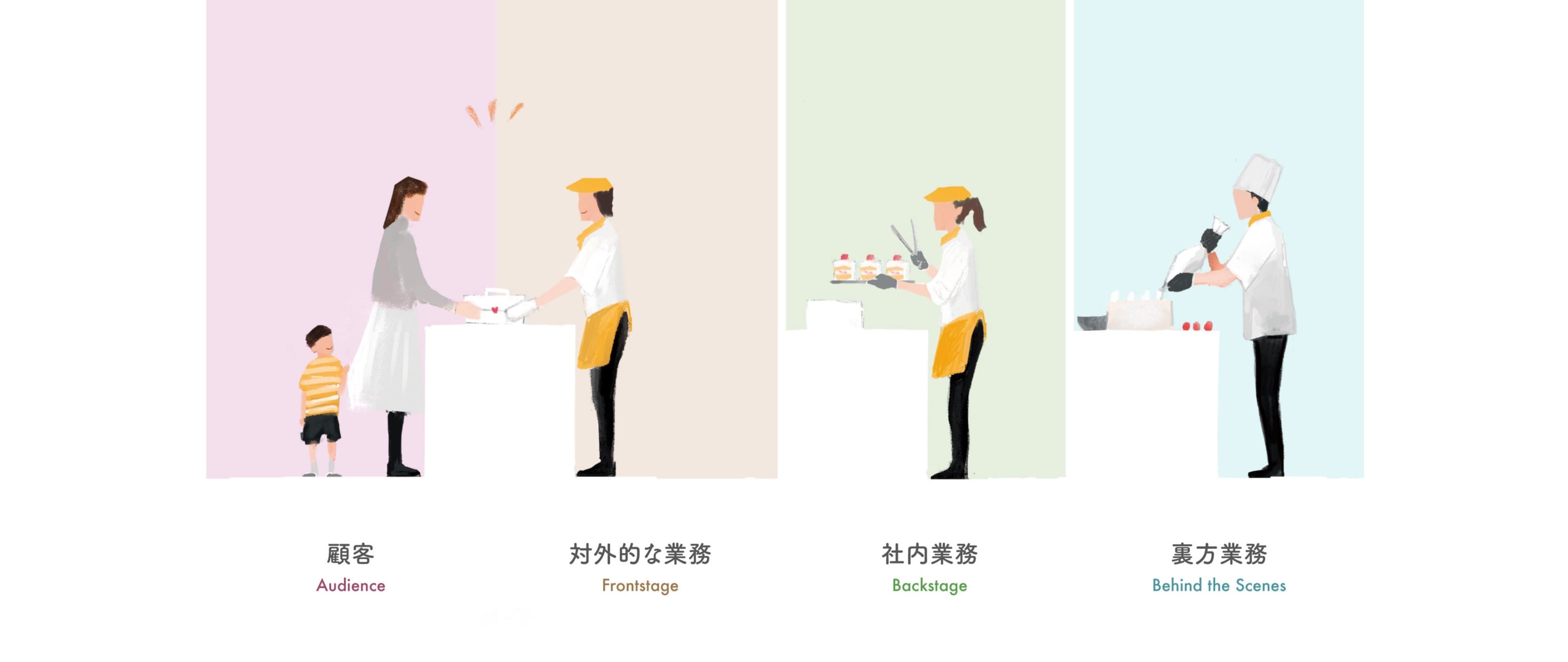
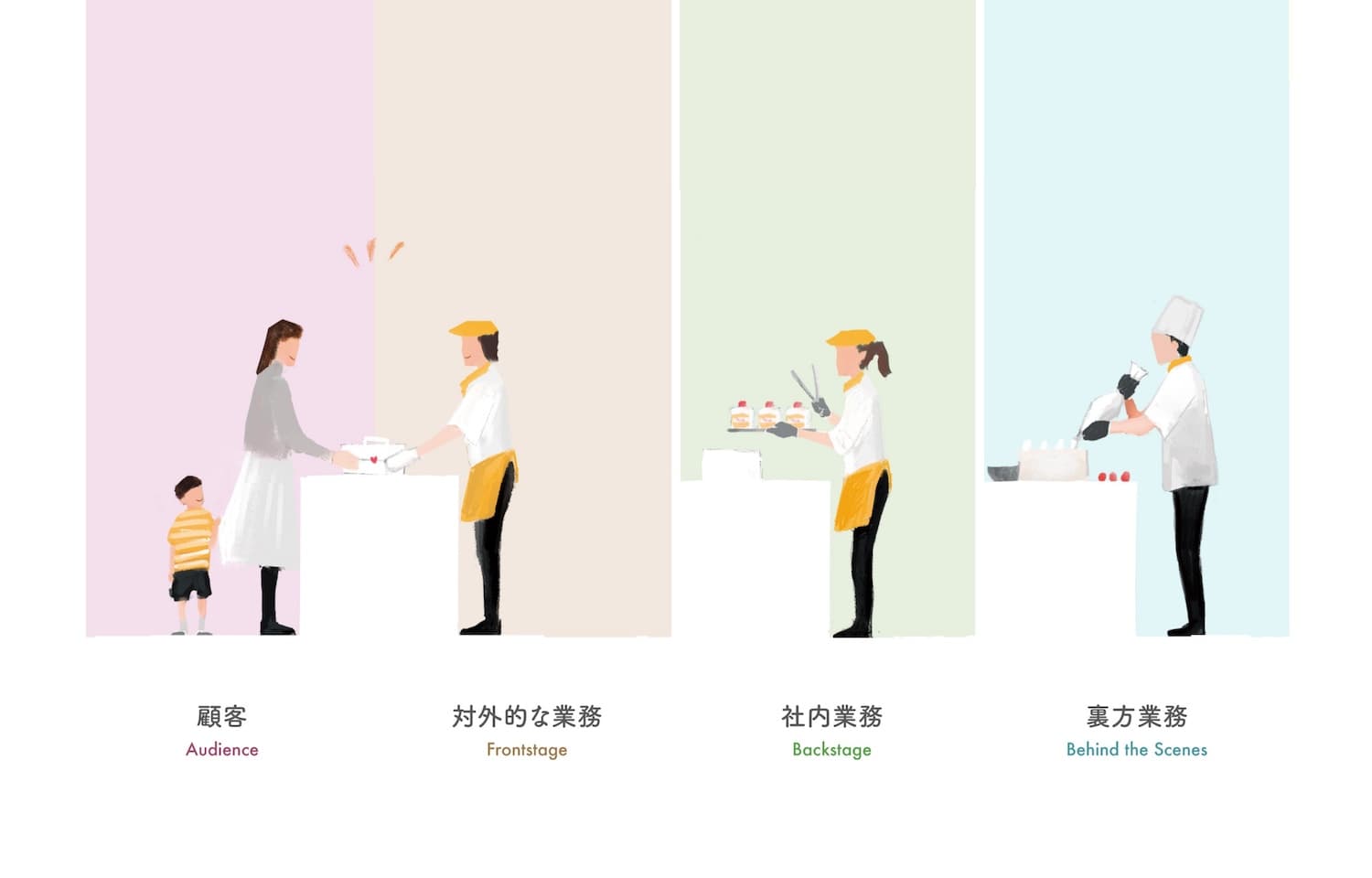
The diagram above shows the four main components of a service blueprint.
From top to bottom, it transitions from the elements directly experienced by the user to the internal processes on the provider’s side (the backstage).
The relationships between elements are connected with arrows, and the flow proceeds from left to right along a timeline.
By effectively utilising a service blueprint, you can identify service issues and connect them to improvements in the user experience. However, it is important to stay aware of the overall picture throughout the process and to maintain a user-centric perspective at all times.
Choose the Right Level of Detail
目的に応じて適切な詳細レベルを設定し、全体像を見失わないようにしましょう。レベルを細かくしすぎると作成に時間がかかってしまいますので、全体像を俯瞰できるツールであることを意識して作成してみましょう。
Involve Multiple Team Members
- 企画、開発、営業、カスタマーサポートなど、さまざまな部門のメンバーの意見を取り入れて作ることで全体像がよりクリアになります。
Reflect Actual Operations
- 現場の声を反映し、現実的な設計を心がけましょう。
Maintain a User Perspective
- サービスのプロセスで見えない改善点を可視化する際には、常にユーザーの視点に立って作成することが重要です。
Review Regularly
- サービスは環境や要因によって常に変化します。都度必要性を感じたときに定期的に見直し、必要な改善を行うことで最適な結果を得ることができます。
The Difference Between a Service Blueprint and a Customer Journey Map
Both the service blueprint and the customer journey map are essential tools in service design, but they serve different purposes and are used at different stages of the process.
A service blueprint is typically created after analysing the insights gained from a customer journey map. Let’s look at their key differences below.
1. Point of View
- サービスブループリント: サービス提供者と顧客の両方の視点を含む
- カスタマージャーニーマップ: 主に顧客の視点に焦点を当てる
2. Purpose
- サービスブループリント: サービス全体の業務フローを改善する
- カスタマージャーニーマップ: 顧客体験の課題を見つけ、改善する
3. Content
- サービスブループリント: 顧客の行動に加え、フロントステージ、バックステージ、サポートプロセスを含む
- カスタマージャーニーマップ: 顧客の行動、感情、思考の変化を詳細に描く
4. When It’s Used
- サービスブループリント: カスタマージャーニーマップの分析後に活用されることが多い
- カスタマージャーニーマップ: サービス設計の初期の段階で使用されることが多い
5. Focus
- サービスブループリント: サービス提供者と顧客のリアルタイムでのやり取りに焦点を当てる
- カスタマージャーニーマップ: 顧客の全体的な体験プロセスに焦点を当てる
この2つのツールは補完的な関係にあり、サービスの全体像を把握し改善するために組み合わせて使用されることが多いです。
In Conclusion
<p>A service blueprint is a valuable tool that visually and chronologically organises the process by which a product or service is delivered to the customer.
By mapping each step, it helps everyone involved in the service understand their roles and identify areas for improvement.<br>
At BOEL, we actively use this framework when working with clients on product development and service designprojects.
If you’re interested in learning how to apply it to your organisation or project, please feel free to contact us.</p>
RECENT POSTS

Vol.198
From parent–child bonds to community: The future of education that nurtures diversity and designs relationships

Vol.197
Exploring the future of environmental design integrating vision, diversity, and a future-oriented perspective

Vol.196
Vision-making for diverse and future-oriented education: Interpreting the future of learning through environmental design

Vol.195
“One Health” and Japan — Toward an Era of Integrating Humans, Animals, and the Environment

Vol.194
The benefits and challenges of digital education in the AI era, and the future of learning

Vol.193
Vision-Making in the age of AI — How artificial intelligence is transforming the meaning of work and the nature of organizations
TRENDING

Vol.164
Steps and strategies for internal branding to enhance employee engagement

Vol.160
What Small and Medium-sized Enterprises Should Do About Employer Branding

Vol.159
User behavior by design | The psychology of UX and behavioral change
INDEX
What is a Service Blueprint?
Expected Benefits of Using a Service Blueprint
Advantages and Disadvantages of a Service Blueprint
Concrete Steps for Creating a Service Blueprint
Key Points to Keep in Mind When Creating a Service Blueprint
The Difference Between a Service Blueprint and a Customer Journey Map
In Conclusion



MORE FOR YOU

おもてなしから学ぶUXデザイン
2021.12.10
顔が見えない時代のコミュニケーション戦略
2024.3.25
Frameworks useful for developing brand strategy
2021.2.1
Airbnb 創業者 Joe Gebbiaのビジョン戦略|ストーリーボードでビジョンを描く
2025.2.26
What is Design Thinking? A Thorough Explanation from the Basics to Its Evolved Forms
2025.8.29
What is strategic design for shaping a business strategically?
2025.5.16
From parent–child bonds to community: The future of education that nurtures diversity and designs relationships
2025.12.19