BRANDING
Vol.173

T.M.
The relationship between DX promotion and branding:DX and brand strategy for SMEs
At the same time, “branding” and “brand strategy,” which convey a company’s unique identity and value, are receiving renewed attention. So, are DX promotion and brand strategy completely independent efforts?
In fact, DX promotion and branding are closely interconnected. In this article, we explain in an easy-to-understand way the relationship between DX and branding, and how mid-sized and small companies can effectively integrate the two.


What Is DX Promotion?
Definition of DX
DX (Digital Transformation) refers to fundamentally transforming business models, organizational culture, and operational processes through the use of digital technologies. It is not merely digitization (such as converting paper documents into PDFs), but an initiative that changes the overall way a company operates.
Incidentally, in the "DX Promotion Guide 2025 for Mid-sized and Small Enterprises" introduced at the beginning, it is defined as "efforts to transform business models and corporate culture in order to create new value from a customer perspective, and not simply the introduction of digital technologies or tools, but a transformation of corporate management itself."
In other words, it is reasonable to understand DX as the overall initiative of transforming corporate management and culture through the use of digital technologies and tools.
Why DX Is Needed Now
The increasing importance of DX for companies can be attributed to the following social conditions and challenges.
• Diversification of customer needs and accelerating pace of change
• Declining labor population and the need to improve productivity
• Intensifying competition and globalization
• Changes in work styles due to the COVID-19 pandemic
It is no exaggeration to say that promoting DX is a “survival strategy” for companies to respond to these challenges and conditions.
However, in reality, many companies have merely introduced digital tools without effectively utilizing them, resulting in DX in name only.
According to materials such as "DX Trends 2024: Status of DX Initiatives (Year-on-Year Changes and Comparison with the U.S.)" by the Information-technology Promotion Agency (IPA), and "Survey on DX Promotion in Small and Medium-sized Enterprises (2024)" by the Organization for Small & Medium Enterprises and Regional Innovation, Japan,
while a considerable number of mid-sized and small enterprises are proactive about or have introduced DX, it is noteworthy that many have not progressed to the stage of effectively utilizing digital tools or achieving tangible improvements in productivity and efficiency.
Various factors can be considered, but based on the previously mentioned materials, the author believes that the shortage of IT and AI talent may become an even more serious issue in the future.
If you would like to learn more about the current state of DX promotion, please refer to the materials below.
References: • Information-technology Promotion Agency (IPA), "DX Trends 2024: Status of DX Initiatives (Year-on-Year Changes and Comparison with the U.S.)"
• Organization for Small & Medium Enterprises and Regional Innovation, Japan, "Survey on DX Promotion in Small and Medium-sized Enterprises (2024)"
Where DX and Branding Intersect
We have briefly introduced the definition of DX and the background behind its promotion.
Now, let’s move on to the main topic of this article. How are DX promotion and branding related?
In this article, we will explain from the following three perspectives.
(*) If you would like to learn more about branding, we have published several related articles in the past, so please feel free to refer to those as well.
Optimization of Customer Experience (CX)
As DX diversifies and digitalizes customer touchpoints, it becomes essential to maintain consistency with the brand image.
For example:
• Design and usability of e-commerce websites
• Quality of online customer support interactions
• Personalized emails and advertisements
All of these elements shape the customer’s brand experience. Data utilization and system implementation driven by DX support the core of branding—“experience value.”
Internal Branding and Corporate Culture
To advance DX, internal mindset transformation is indispensable. In other words, a culture where employees can take on challenges without fear of change is required. Embedding brand strategy into corporate culture increases the likelihood of successful DX implementation.
For example, the following initiatives can be implemented:
• Development of internal brand guidelines
• Brand workshops for employees
• Brand awareness initiatives aligned with DX projects
Visualization of Brand Value and Strengthening Communication Power
Data obtained through DX can also contribute to strengthening brand strategy.
• Visualization of customer needs based on data
• Quantification of brand evaluation through social media and web analytics
• Brand storytelling using owned media and social media
In other words, DX is a powerful tool for “making brand value visible and enhancing the ability to communicate it effectively.”

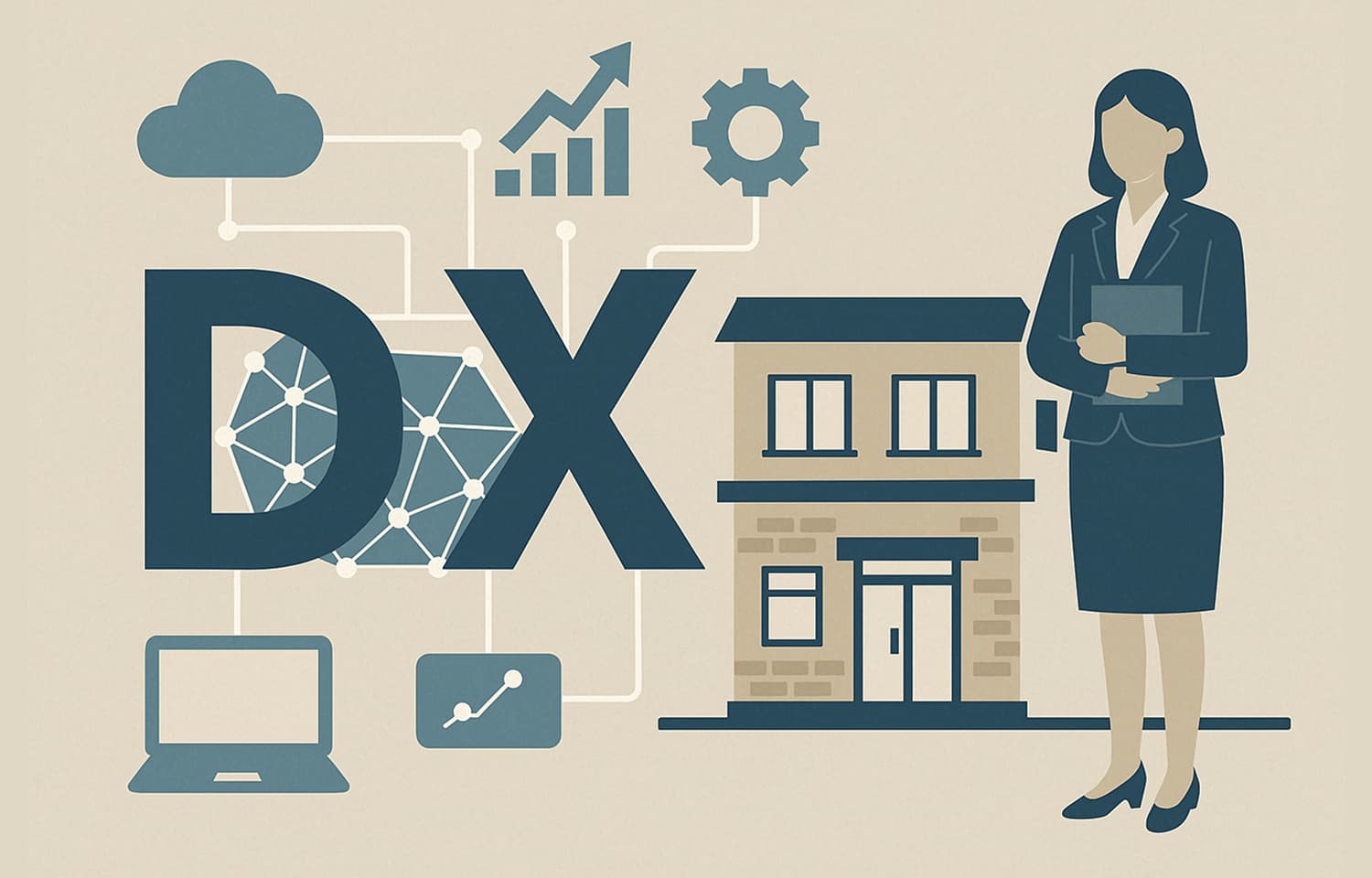
Steps for SMEs to Implement DX × Branding
When people hear DX, they often think it is something for large corporations. However, in reality, mid-sized and small enterprises, with their smaller management scale and faster decision-making by executives, are often better positioned to implement new initiatives, resulting in quicker organizational transformation and more immediate outcomes.
From the perspective of flexibility as well, it can be said that mid-sized and small enterprises, as well as startups, have significant advantages when it comes to leveraging DX.
What Does DX Mean for SMEs?
For SMEs, DX is not merely about introducing IT, but rather a management strategy that leverages digital technologies to enhance operational efficiency, customer experience, and competitiveness.
In particular, the following three perspectives are important:
• Improving operational efficiency (enhancing productivity)
• Strengthening customer touchpoints (marketing and sales)
• Accelerating management decision-making (data utilization)
DX Areas That SMEs Can Easily Address
[Operational Efficiency]
• Introduction of cloud accounting software (e.g., freee, Money Forward)
• Digitization and paperless invoicing
• Automated inventory management systems (e.g., Aladdin Office, Smart Inventory Management)
• Development of remote work environments (Google Workspace, Microsoft 365, etc.)
[Digitalization of Customer Touchpoints]
• Building e-commerce websites (STORES, BASE, Shopify, etc.)
• Information dissemination and brand awareness expansion through social media operations
• Customer support and sales promotion via LINE official accounts
• Web-based reservation and inquiry forms
[Customer Management and Sales DX]
• Utilization of CRM (Customer Relationship Management) tools (e.g., Zoho, HubSpot)
• Continuous engagement with prospects through MA (Marketing Automation)
• Visualization of sales activities (SFA tools)
How SMEs Can Promote DX: 4 Steps
The following table outlines steps that SMEs can follow without undue burden.
| Step | Action | Key Point |
|---|---|---|
| Step 1 | Identify issues | Pinpoint inefficiencies, manual work, and time-consuming processes |
| Step 2 | Introduce small-scale digital initiatives | Start with a pilot in a single department or workflow |
| Step 3 | Explain and involve employees | Address concerns about new tools and share objectives |
| Step 4 | Evaluate results and improve | Set KPIs and regularly assess cost-effectiveness |
Support Programs Available for Promoting DX
When SMEs engage in DX initiatives, utilizing public support programs can be both beneficial and effective. Below are some representative programs.
| Support Program Name | Details |
|---|---|
| IT Introduction Subsidy | Subsidizes up to 3/4 of IT tool implementation costs (maximum 4.5 million yen) |
| Monozukuri Subsidy | Provides up to 12.5 million yen for DX-related equipment and software |
| Business Restructuring Subsidy | Supports up to 100 million yen for business transformation, including DX |
(*) As details and budgets change annually, please check the latest information from the Ministry of Economy, Trade and Industry.
What Are the Keys to Successful DX for SMEs?
The success of DX in SMEs depends on the following mindset and approach.
• Don’t aim for perfection—start with 60%
→ Rather than striving for perfection, it is important to begin quickly with a sense of speed.
• Focus on “management transformation,” not just “tool implementation”
→ Instead of simply introducing convenient tools, think from the perspective of how to deliver value to customers.
• Emphasize employee involvement and education
→ Create systems where employees feel they are “empowering themselves with digital tools,” rather than being “forced to use them.”
• Collaborate with external partners
→ Working with reliable partners such as IT vendors, local support organizations, and DX consultants can help reduce the burden.
What Is the Future of DX and Branding?
Going forward, companies will need to move away from viewing DX and branding as separate projects and instead adopt an integrated approach as “DX that enhances brand value.”
Designing DX Based on Brand Purpose
Clearly define “what social issues the company aims to solve” and “why it exists,” and design DX to communicate that purpose.
For example:
• A community-focused company analyzes local voices using AI to develop products
• An environmentally conscious brand introduces IoT to visualize CO2 reduction
Through these efforts, the “essence” of the brand is integrated with technology.
Creating Participatory Brand Experiences
Through DX, customers shift from simply “consuming” a brand to “co-creating” it.
• Adopting fan ideas from social media
• Reflecting customer feedback in product improvements
• Building online communities (Discord, Slack, etc.)
These approaches generate loyalty and sustainably enhance brand value.
Finally, we have summarized the integrated concept of DX and branding in the diagram below.
In the future, branding and DX will become inseparable. Rather than focusing on one or the other, companies must build their management approach on the dual axes of “technology × purpose” and “efficiency × emotion.”
At the same time, as technology becomes more advanced, “stories that move people” and “values that resonate” will become increasingly important.
Conclusion
What did you think?
There is one final point we would like to share.
No matter how much technology evolves, the essence of brand strategy lies in “how it resonates with people’s hearts.” DX is merely a means to achieve that, and by integrating both, companies can realize sustainable growth.
DX promotion and branding are the two wheels driving companies toward the future. However, rather than focusing on one or the other, as illustrated in the diagram introduced earlier, it is the “strategic perspective of designing both in an integrated manner” that will be the key to creating next-generation competitiveness.
RECENT POSTS

Vol.198
From parent–child bonds to community: The future of education that nurtures diversity and designs relationships

Vol.197
Exploring the future of environmental design integrating vision, diversity, and a future-oriented perspective

Vol.196
Vision-making for diverse and future-oriented education: Interpreting the future of learning through environmental design

Vol.195
“One Health” and Japan — Toward an Era of Integrating Humans, Animals, and the Environment

Vol.194
The benefits and challenges of digital education in the AI era, and the future of learning

Vol.193
Vision-Making in the age of AI — How artificial intelligence is transforming the meaning of work and the nature of organizations